Basketball Terms and Phrases

  • Assist: A pass that directly leads to a made basket.
  • Backboard: The rectangular board behind the basket. The ball can be bounced off the backboard to score.
  • Backcourt: The half of the court that contains the opponent’s basket. It’s also the term used for the guards on a team.
  • Bank Shot: A shot where the ball is bounced off the backboard and into the basket.
  • Baseline: The boundary line behind each basket.
  • Box Out: A technique used to position oneself to get a rebound by blocking an opponent.
  • Charge: An offensive foul where the player with the ball runs into a stationary defender.
  • Crossover Dribble: A dribbling move where the player quickly changes the ball from one hand to the other to avoid a defender.
  • Double-Double: A statistic where a player records ten or more in two statistical categories (e.g., points and rebounds) in a single game.
  • Double Dribble: A violation where a player dribbles the ball, stops, and then starts dribbling again.
  • Fast Break: A quick offensive move towards the basket after a defensive rebound or steal.
  • Field Goal: Any basket scored from the floor, not including free throws.
  • Free Throw: A shot taken from the free-throw line, awarded after certain fouls.
  • Full-Court Press: A defensive strategy where the defense applies pressure on the offense across the entire court.
  • Goaltending: A violation where a player interferes with the ball on its way to the basket or while it’s on the rim.
  • Half-Court Shot: A shot taken from or near the half-court line, usually at the end of a period.
  • Jump Shot: A shot taken while jumping, usually from a distance away from the basket.
  • Layup: A close-range shot taken by laying the ball up near the basket, usually off the backboard.
  • Man-to-Man Defense: A defensive strategy where each defender is responsible for guarding one opponent.
  • Pick-and-Roll: An offensive play where a player sets a screen (pick) for a teammate handling the ball and then rolls towards the basket.
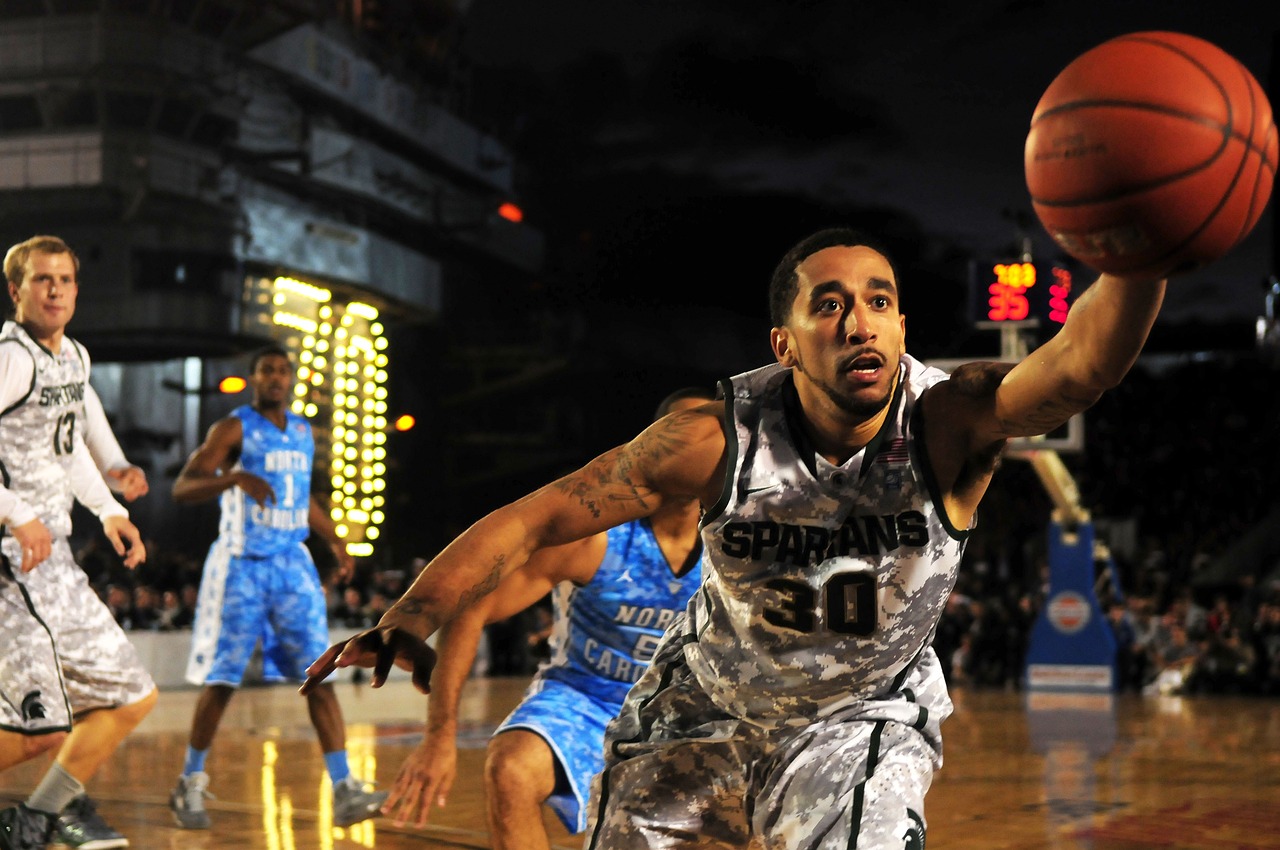
  • Rebound: When a player retrieves the ball after a missed shot attempt.
  • Screen: A legal block by an offensive player to free up a teammate for a shot or pass.
  • Shot Clock: The timer that limits how long a team can possess the ball before attempting a shot (typically 24 seconds in the NBA).
  • Three-Point Line: The arc around the basket that marks the distance from which shots are worth three points.
  • Traveling: A violation where a player takes too many steps without dribbling the ball.
  • Triple-Double: A performance where a player records ten or more in three statistical categories in a single game.
  • Turnover: When a team loses possession of the ball to the opponent.
  • Zone Defense: A defensive strategy where players guard areas of the court instead of specific opponents.

Basketball Organizations and Competitions

  • NBA (National Basketball Association): The premier professional basketball league in the United States and the most recognized in the world.
  • WNBA (Women’s National Basketball Association): The professional women’s basketball league in the United States.
  • NCAA (National Collegiate Athletic Association): The organization that governs college basketball in the United States.
  • FIBA (Fédération Internationale de Basketball): The international basketball federation that governs international competitions, including the World Cup of Basketball.
  • EuroLeague: The top professional basketball league in Europe, featuring the best teams from across the continent.
  • BCL (Basketball Champions League): A professional basketball competition for European clubs, organized by FIBA.
  • NBA G League: The NBA’s official minor league, serving as a development platform for young players.
  • NBL (National Basketball League): A professional basketball league based in Australia.
  • CBA (Chinese Basketball Association): The top professional basketball league in China.
  • ACB (Asociación de Clubs de Baloncesto): The top professional basketball league in Spain.
  • BSL (Basketball Super League): The top professional basketball league in Turkey.

International Competitions

  • FIBA Basketball World Cup: The premier international basketball competition, held every four years, where national teams from around the world compete.
  • Olympic Basketball: A competition held every four years during the Summer Olympics, featuring the world’s best national teams.
  • EuroBasket: A European championship tournament for national teams, organized by FIBA Europe.
  • AmeriCup: An international basketball competition featuring teams from the Americas, organized by FIBA.
  • AfroBasket: The African continental basketball championship, organized by FIBA Africa.
  • Asian Cup: A basketball championship tournament for national teams in Asia, organized by FIBA Asia.

Additional Terms and Concepts

  • All-Star Game: An exhibition game that features the best players from a league, typically the NBA or WNBA.
  • MVP (Most Valuable Player): An award given to the best-performing player, either for a specific game, series, or season.
  • Sixth Man: A term used to describe the first player off the bench, typically someone who contributes significantly despite not starting.
  • Rookie: A player in their first season of professional basketball.
  • Draft: The annual event where teams select eligible players to join the league, primarily from college basketball or international leagues.
  • Free Agency: A period when players who are not under contract with a team can be signed by any team.
  • Salary Cap: A limit on the total amount of money that a team can spend on player salaries.
  • 3-and-D Player: A player who specializes in three-point shooting and defense.
  • Heat Check: When a player who is “on fire” takes a difficult shot to test how “hot” they are.

Random Articles & Posts

The 1984 Summer Olympics in Los Angeles marked a triumphant return for Olympic basketball, following…

After a decade without professional basketball, Mexico City reentered the hoops scene with the founding of the Capitanes — a privately backed team that reignited the country’s passion for the game.

Basketball in England: news, leagues, players, and development. Explore how the sport is expanding across the nation.

The history of internationally born All-Stars in the NBA is a testament to the sport’s global evolution, from pioneers like Hakeem Olajuwon to modern icons like Giannis Antetokounmpo and Luka Dončić. Their exceptional talents not only showcase the diversity of basketball but also serve as cultural bridges, inspiring fans worldwide and contributing to the sport’s global growth. As the NBA continues to embrace international talent, the legacy of these All-Stars will undoubtedly shape the league’s future, reinforcing basketball’s status as a universal language that unites people across borders and cultures.

Tanking in pro basketball became one of the NBA’s defining modern debates because it turned losing into something more complicated than failure. In a league where elite talent can transform a franchise, the draft became a path to hope for teams stuck outside contention. That created a difficult incentive: if being bad enough could improve a team’s odds of landing a future star, then losing could start to look like strategy. Tanking matters because it sits at the center of the NBA’s biggest tension between fairness and entertainment. The league wants weaker teams to improve, but it also needs every game to feel honest, competitive, and worth watching.

The Draft Made Losing Feel Like a Path to Hope

The logic behind tanking starts with the NBA Draft. Basketball is unusually star-driven, and one player can change a franchise’s direction more dramatically than in most team sports. A top pick can become a scorer, defensive anchor, cultural figure, ticket seller, and long-term identity. That reality makes draft position extremely valuable.

For struggling teams, the draft is supposed to create balance. The worst teams get the best access to young talent, giving them a way back toward relevance. In theory, that is good league design. It prevents permanent hopelessness and gives fan bases a reason to believe the next era could be different.

The problem is that the same system can reward losing. When a team realizes it is not good enough to contend and not bad enough to land a top prospect, the middle can feel like the least useful place to be. That is where tanking becomes tempting. A franchise may trade veterans, prioritize younger players, accept short-term losses, and build around future draft picks instead of chasing a low playoff seed.

Not every rebuild is tanking. Some teams lose because they are young, injured, poorly constructed, or starting over after a major roster change. Tanking is different because it raises the question of intent. The issue is not simply that a team loses games. The issue is whether a franchise is making choices that reduce its chance to win now because it believes losing will create better odds later.

Tanking Turned Rebuilding Into a Public Strategy

Tanking became especially controversial when it stopped being hidden. In earlier eras, bad teams might quietly shift toward the future. In the modern NBA, fans, media, and front offices can openly discuss draft positioning, asset accumulation, lottery odds, and long-term timelines. Rebuilding became a public language.

The clearest modern example is the Philadelphia 76ers’ “Process” era. Philadelphia accepted years of losing while collecting draft picks, young players, and financial flexibility. The plan was built around the idea that ordinary mediocrity was not enough. The franchise needed access to elite talent, and the draft was the most realistic path.

That strategy was polarizing because it exposed the incentives already built into the system. Supporters saw a franchise refusing to settle for short-term respectability. Critics saw a team reducing the quality of the regular season and asking fans to endure years of losses in exchange for a future that was never guaranteed.

The debate spread beyond Philadelphia because other teams faced similar choices. A franchise near the bottom of the standings could shut down veterans, trade useful players, or lean into player development late in the season. A few extra losses might improve draft position. A slightly worse record might alter lottery odds. Even when players and coaches continued competing, the front office’s long-term plan could point in a different direction.

That divide is what makes tanking so difficult to define. Players usually do not want to lose. Coaches usually do not want losses attached to their records. Fans do not want meaningless basketball for months at a time. But front offices are paid to think beyond one night, one week, or one season. Tanking lives in that space between present competition and future roster construction.

Why the NBA Still Struggles to Solve Tanking

The NBA has tried to reduce tanking by changing the lottery system. Flattened odds made it harder for the worst team to gain a clear advantage over the next-worst teams. That reform was meant to weaken the incentive to chase the league’s worst record. But it did not eliminate the underlying issue: the draft still offers the cleanest route to a transformational young star.

That is why tanking remains hard to solve. If the worst teams get no advantage, rebuilding becomes even harder. If they get too much advantage, losing becomes too attractive. The league has to balance competitive integrity with the need to help struggling teams improve.

There is also a fan psychology problem. Supporters can dislike losing while still understanding the logic behind it. A fan base may reject a poor product in the present but still study lottery odds, draft boards, and prospect highlights. Tanking turns fans into future investors. The season becomes less about the standings and more about the next draft class.

The long-term impact is visible across the league. Teams now think more carefully about timelines, pick protections, salary flexibility, and when to compete. A franchise can be criticized for tanking, but it can also be criticized for staying mediocre too long. That tension keeps the issue alive.

Tanking in pro basketball is not just about losing games. It is about how teams value hope, how leagues design incentives, and how fans survive a rebuild. The NBA can keep adjusting the lottery, but the core issue will remain as long as one draft pick can change a franchise’s future.